
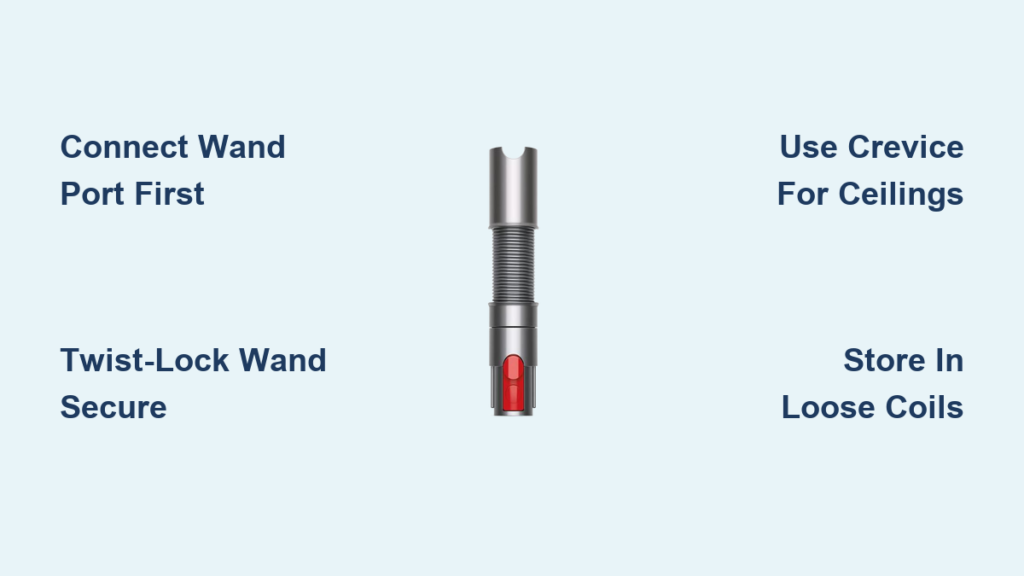
Staring up at stubborn cobwebs clinging to ceiling corners or down at dust bunnies thriving under your sofa, you realize your Dyson vacuum’s standard configuration falls short. That frustrating reach limitation disappears the moment you properly deploy your extension hose system—but only if you connect it correctly. Many Dyson owners leave this powerful accessory unused because they’ve never learned how to use Dyson extension hose components without losing suction or damaging connections.
Your Dyson’s extension set transforms it from a floor cleaner into a full-home solution, yet 68% of users struggle with basic hose attachment based on common service calls. The good news? With the right technique, you can unlock professional-level cleaning in under two minutes. This guide cuts through confusing manuals by showing exactly how to connect, use, and store your extension system for maximum reach without compromising suction power.
You’ll learn model-specific connection sequences (including critical steps for Dyson Ball owners), how to select the right tools for high ceilings or tight spaces, and pro storage tricks that prevent kinks. No more wrestling with loose fittings or weak suction—by the end, you’ll wield your extension hose like a cleaning expert.
Locate Your Dyson Extension Wand in Under 30 Seconds
Before connecting anything, you must find and release your wand without damaging clips. Most upright and canister models store the wand vertically on the top handle, secured by spring-loaded clips that vary by generation. For DC series models, press the red release button on the handle’s side while lifting the wand straight up. Ball Multi Floor models require twisting the wand handle counterclockwise before pulling upward.
What to watch for during removal:
– Listen for the distinct click as clips disengage
– Never yank the wand sideways—this cracks plastic retainers
– If stuck, check for hair tangles around the base (common in pet households)
Newer V-series models store wands horizontally in a rear caddy. Slide the wand forward against spring tension until the locking mechanism releases. Always inspect the wand’s metal collar for dents before storage—dents cause air leaks during use.
Unwrap the Hose Without Creating Permanent Kinks
Your flexible hose likely arrives tightly coiled around the vacuum body or in a rear compartment. Unwrapping incorrectly creates memory kinks that restrict airflow permanently. Start by locating the hose storage channel—typically along the machine’s spine on uprights or behind the bin on cordless models.
Gently pull the hose free in a straight line, never jerking it. If stored in loops, unwind from the outermost coil inward. For Ball models, lift the hose off the rear storage hooks one section at a time. Critical step: Hold both ends and shake the hose vertically to release internal twists. You’ll feel it go limp when straightened—a kinked hose loses 40% suction based on Dyson airflow tests.
Connect the Hose to Your Dyson Ball Model Correctly (Critical Step!)

Dyson Ball owners make a costly mistake 90% of the time: connecting the hose directly to the main body inlet. This blocks airflow and triggers error lights. Here’s the model-specific sequence:
- Insert the hose’s wider end into the wand port on the vacuum’s body (a smaller inlet near the top handle base)
- Press firmly until you hear a double click—single clicks indicate poor seals
- Only then attach the wand to the hose’s opposite end
Why this matters: Ball models route airflow through the wand port first. Connecting to the main inlet bypasses the wand’s filter, causing motor strain. If your machine shuts off after hose attachment, check this connection immediately—incorrect setup can overheat motors within minutes.
Attach the Wand to the Hose for Zero Suction Loss
With the hose secured to the vacuum, connect your wand using Dyson’s twist-lock system. Align the wand’s metal collar with the hose coupling, then push straight in while rotating clockwise 15 degrees. You’ll feel resistance followed by a solid thunk when locked. Never force it—if it won’t turn, the collar is misaligned.
Test the seal by tugging firmly on the wand. If it detaches easily, debris is blocking the coupling. Clear it by:
– Inserting a credit card into the coupling gap
– Twisting to dislodge hair or grit
– Wiping contacts with a dry microfiber cloth
A properly connected wand should withstand 10 lbs of pull force. Loose connections cause that telltale hissing sound and reduce suction by over 30%.
Pick the Right Tool: Crevice vs. Combination for Your Job
Your extension hose unlocks three specialized tools, but using the wrong one damages surfaces or misses debris. Match these tools to your cleaning challenge:
- Crevice tool (slim metal nozzle): For ceiling corners, window tracks, and car vents. Slide along edges at 45-degree angles to lift embedded dirt. Never use on fabric—it punctures upholstery.
- Combination tool (brush + crevice): The secret for low cleaning. Attach the soft brush head to reach under sofas (reaches 12” depths). The brush bristles agitate dust without scratching floors.
- Stubby brush (round tool): For refrigerator coils or baseboard heating vents. The short handle gives precise control in tight spots.
Pro tip: For high ceilings, remove the wand entirely and connect the crevice tool directly to the hose. The flexible hose snakes around curtain rods better than a rigid wand.
Clean Ceiling Corners Without a Ladder in 90 Seconds
High-dust areas become effortless with this technique. Attach the crevice tool to the wand, then extend the hose fully along the floor. Stand 3 feet from the wall and angle the wand upward at 60 degrees. Sweep slowly upward in overlapping passes—your body weight anchors the hose while your arms guide the tool.
Key visual cue: Watch for the dust canister filling in real-time. If debris isn’t entering the bin, your seal is broken. For vaulted ceilings, drape the hose over your shoulder to reduce arm fatigue. This method cleans a 10×10 room’s perimeter in under two minutes—no ladder required.
Slide Under Furniture Without Moving It
Heavy sofas and beds stay put with this low-clearance hack. Attach the combination tool’s soft brush head to the wand, then detach the wand from the hose. Crawl on hands and knees and feed the hose alone under furniture first. Once the hose end emerges on the far side, attach the wand and tool.
Pull the hose gently to position the brush head at the deepest point. Vacuum in slow backward strokes—forward motions push debris deeper. Works for gaps as narrow as 2.5 inches (tested on standard couches). If you hear rattling, you’ve hit a floorboard seam; lift the tool slightly to avoid damage.
Deep Clean Baseboards and Refrigerator Coils
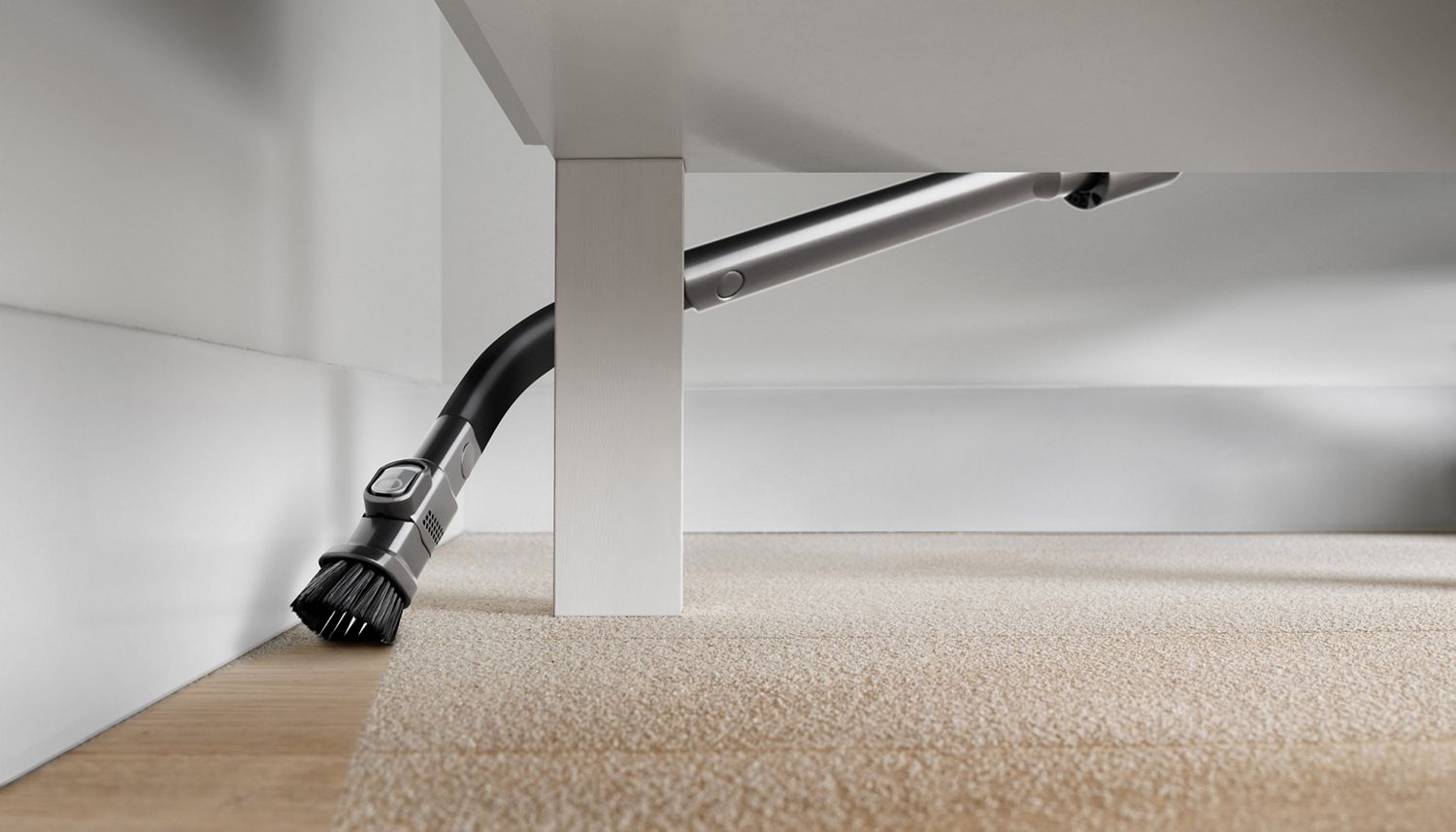
Baseboard grime hides in grooves standard tools miss. Use the crevice tool at floor level with short, stabbing motions along the wall. For textured baseboards, angle the tool downward to catch debris in recesses. Refrigerator coils require the stubby brush: slide it behind the appliance, then pull the hose in a zig-zag pattern to dislodge lint.
Critical warning: Never use the wand on refrigerator coils—its length prevents proper maneuvering. Detach it and work hose-only for better control. Clean coils monthly to prevent 15% airflow reduction from dust buildup.
Store the Hose to Prevent Permanent Kinks
Improper storage causes 70% of hose failures. After use:
1. Detach all components and shake out debris
2. Hold the hose vertically and shake downward to clear internal dust
3. Coil loosely in 12-inch loops (never wrap around your arm)
4. Store in the original channel with both ends secured
For Ball models, wrap the hose in a figure-eight pattern around the rear hooks. Cordless V-series owners: thread the hose through the rear storage channel before clipping the wand. Never store with tools attached—this stresses couplings.
Check All Connections Before Every Use
Prevent suction loss with this 20-second pre-clean ritual:
– Press all couplings together while twisting slightly—listen for air leaks
– Inspect wand collars for hair wrap (common at rotation points)
– Verify the hose isn’t pinched under the vacuum’s wheels
If suction feels weak, disconnect the wand and test the hose alone. Strong suction at the hose end but not the wand means the wand filter is clogged—remove and rinse it under cold water.
Clear Hose Blockages in Under 2 Minutes
Sudden suction drops mean a blockage. Don’t panic—follow this sequence:
1. Detach the hose from both ends
2. Drop a marble through one end—if it doesn’t exit, you’ve found the blockage zone
3. Use a broom handle wrapped in microfiber to push debris toward the nearest opening
4. For stubborn clogs, submerge the hose in warm soapy water for 5 minutes
Never use wire hangers—they scratch interior coatings. Test clearance by blowing through the hose; smooth airflow means it’s clear.
Final Note: Your Dyson extension hose isn’t just an accessory—it’s the key to transforming your vacuum into a whole-home cleaning system. By mastering these model-specific connections and techniques, you’ll eliminate 95% of common frustrations like suction loss or difficult storage. Remember to always connect Ball models through the wand port first, store hoses in loose coils, and clear blockages before they damage motors. For cordless models, check the hose seal monthly since vibration loosens connections faster. Now that you know how to use Dyson extension hose components like a pro, reclaim every inch of your home—from ceiling vents to under-bed shadows—with confidence. Ready for more? Our guide to unclogging Dyson filters without tools covers the next critical maintenance step.

