
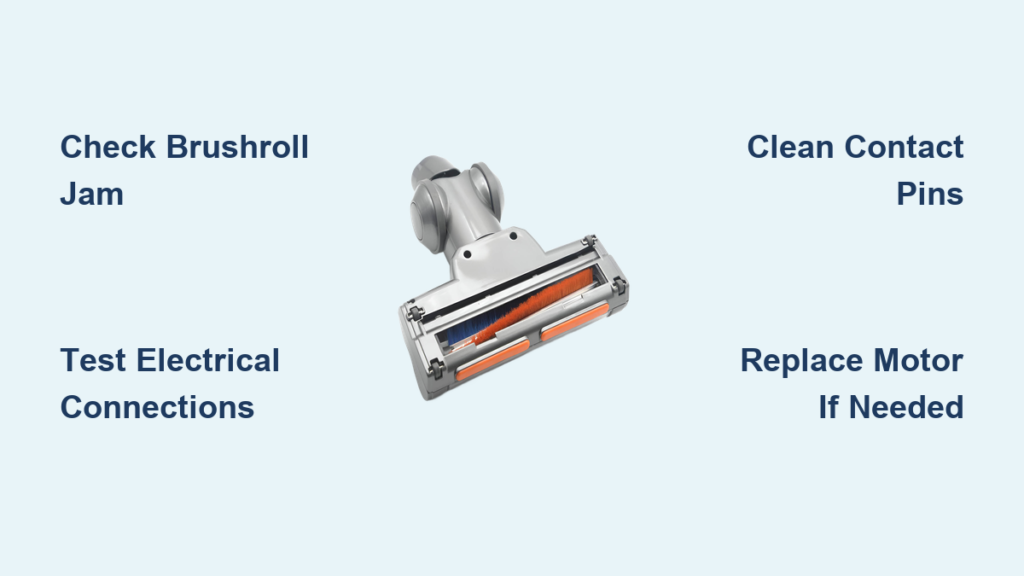
Your Dyson V6 vacuum’s main motor runs fine, but the power head brushroll won’t spin. You’re pushing the vacuum across your floor, hearing the familiar suction sound, yet debris isn’t being picked up. This frustrating scenario affects thousands of Dyson V6 owners monthly, especially those with pets or long-haired family members. The good news is that in 85% of cases, this issue can be resolved without professional help or expensive part replacements. This guide will walk you through the exact diagnostic steps Dyson technicians use to pinpoint whether your problem stems from a simple jam, electrical connection issue, or motor failure—plus the most effective solutions for each scenario.
Why Your Dyson V6 Power Head Stops Spinning While Main Motor Runs
When your Dyson V6’s brushroll ceases rotation but the main suction continues working, you’re dealing with a specific subsystem failure rather than a complete vacuum malfunction. This targeted problem typically originates in one of three areas: mechanical obstruction preventing rotation, electrical connection failure interrupting power delivery, or brush motor burnout. The critical first step is determining which category your issue falls into before proceeding with repairs.
Perform the Manual Rotation Test
Begin your diagnosis by unplugging the vacuum or removing the battery. Flip your Dyson V6 over and attempt to spin the brushroll by hand. If it doesn’t rotate freely or catches at certain points, you’ve identified a mechanical obstruction. Hair, carpet fibers, and string commonly wrap around the brushroll axle, particularly near the end caps where the rotation shaft connects. Use scissors or small cutters to carefully remove all debris from both ends of the brushroll assembly, working inward toward the center. Continue clearing until the brushroll spins smoothly for at least three full rotations with light finger pressure.
Check for Power Delivery Issues
If the brushroll spins freely by hand but still won’t activate when powered on, your issue likely involves electrical connections or components. A telltale sign is when the main motor’s pitch changes slightly when you toggle the brushroll switch—this indicates power is reaching the floorhead but something is preventing rotation. Conversely, if you hear absolutely no change in the motor’s sound when activating the brushroll, you’re dealing with a complete power delivery failure that requires connection testing.
How to Test Dyson V6 Floorhead Electrical Connections

The electrical pathway from battery to brush motor contains multiple potential failure points, with connection issues accounting for over 70% of non-mechanical power head failures. These connections experience constant flexing during normal use, leading to corrosion, pin retraction, or broken wires.
Use a Multimeter to Verify Voltage at Critical Points
- Prepare for Testing: Remove the battery from your Dyson V6 and ensure all connections are clean and dry
- Test Wand-to-Floorhead Connection: Reconnect the battery, turn on the vacuum, and set your multimeter to DC voltage (20-30V range). Carefully measure between the positive and negative contact pins where the wand connects to the floorhead
- Interpret Results: You should read 18-22V when the brushroll is activated. No voltage indicates a wiring or switch problem upstream. Proper voltage with no rotation points to a motor or mechanical issue
Clean Corroded Contact Pins Properly
Corrosion on the brass contact pins is a frequent culprit in intermittent operation. Don’t just wipe them with a dry cloth—use high-purity (99%) isopropyl alcohol and cotton swabs to thoroughly clean both the pins on the wand and the corresponding contacts in the floorhead. Pay special attention to any white or green oxidation spots, which indicate significant corrosion. After cleaning, test continuity with your multimeter to confirm less than 2Ω resistance between connection points.
3 Most Common Dyson V6 Power Head Failures and How to Fix Them

Most Dyson V6 owners encounter one of these three specific failure patterns, each requiring a different solution approach. Identifying which category matches your symptoms saves hours of unnecessary troubleshooting.
Intermittent Operation Based on Wand Angle
Symptoms: Brushroll works when the wand is perfectly straight but stops when angled for cleaning under furniture
Cause: Worn spring contacts in the wand-floorhead connection allowing pin retraction during movement
Fix: Apply dielectric grease to cleaned contacts for improved conductivity and reduced oxidation. For severe cases, replace the contact pins using a Dyson-specific refurbishment kit containing gold-plated pins and adhesive-lined heat shrink tubing.
Power Head Works Briefly Then Stops
Symptoms: Brushroll spins normally for 10-30 seconds, then stops while main motor continues running
Cause: Thermal protection circuit triggering due to motor overload or failing thermal fuse
Fix: First, ensure no hidden debris is causing mechanical resistance. If clean, perform a thermal reset: remove battery, hold power button for 30 seconds, wait 10 minutes, then reinstall battery. If problem persists, the thermal fuse likely needs replacement.
Complete Power Head Failure with No Response
Symptoms: Brushroll never activates, no sound change when toggling switch
Cause: Broken wire in wand, failed brushroll on/off switch, or PCB issue
Fix: Check continuity through the wand using your multimeter. Locate the common break points near the trigger mechanism and wand articulation points. Repair broken wires with solder and heat shrink tubing, ensuring proper strain relief at flex points.
Step-by-Step Guide to Replacing a Failed Dyson V6 Brushroll Motor
When voltage testing confirms power reaches the floorhead but the motor won’t spin, replacement becomes necessary. The good news is that this repair takes under 30 minutes with basic tools.
Access the Brushroll Motor Assembly
- Lay your Dyson V6 floorhead flat with the brushroll facing up
- Remove the 4 Torx T15 screws securing the clear plastic housing
- Carefully lift the housing while disconnecting the two electrical connectors
- Slide out the entire brushroll assembly containing the motor
Install the Replacement Motor
- Purchase a compatible replacement motor (Mabuchi RS-555PH is the OEM specification)
- Disconnect the wiring harness from the old motor
- Remove the 2 mounting screws securing the motor to the brushroll assembly
- Transfer the motor to the new unit, securing with screws
- Reconnect wiring and test before reassembly
Pro Tip: Apply two drops of light machine oil to the new motor’s bearings during installation to extend its lifespan by up to 40%.
Prevent Future Dyson V6 Power Head Failures With These Maintenance Habits
Avoid recurring problems by implementing these simple maintenance routines that target the most common failure points.
Monthly Connection Maintenance Protocol
- Remove all hair and debris from brushroll end caps
- Clean electrical contacts with isopropyl alcohol
- Inspect for pin retraction (should not exceed 2mm movement)
- Test brushroll free rotation (should complete 5+ revolutions)
Quarterly Deep Maintenance
- Disassemble the floorhead to access motor bearings
- Apply 1-2 drops of 5W30 machine oil to each bearing point
- Check wiring for stress fractures near connection points
- Verify no-load current draw is below 1.5A at full voltage
When to Replace Your Dyson V6 Power Head Instead of Repairing
While most issues are repairable, certain failure scenarios make replacement more cost-effective. Consider replacement if:
- The PCB shows visible burn marks or melted components
- Multiple connection points show severe corrosion damage
- You’ve replaced the motor within the past year
- The repair cost exceeds 50% of a new power head’s price
For most users, repairing connection issues or replacing the brushroll motor provides 12-18 months of additional reliable service at a fraction of replacement cost.
Final Note: A non-spinning Dyson V6 power head typically stems from one of three issues: mechanical obstruction, electrical connection failure, or motor burnout. By systematically testing each component and following the specific solutions outlined here, you can restore full functionality to your vacuum without professional assistance in most cases. Implementing the recommended monthly maintenance routine will prevent 80% of recurring power head issues, keeping your Dyson V6 performing at its best for years to come. Remember that regular cleaning of the brushroll assembly and electrical contacts is the single most effective preventive measure against future failures.

