
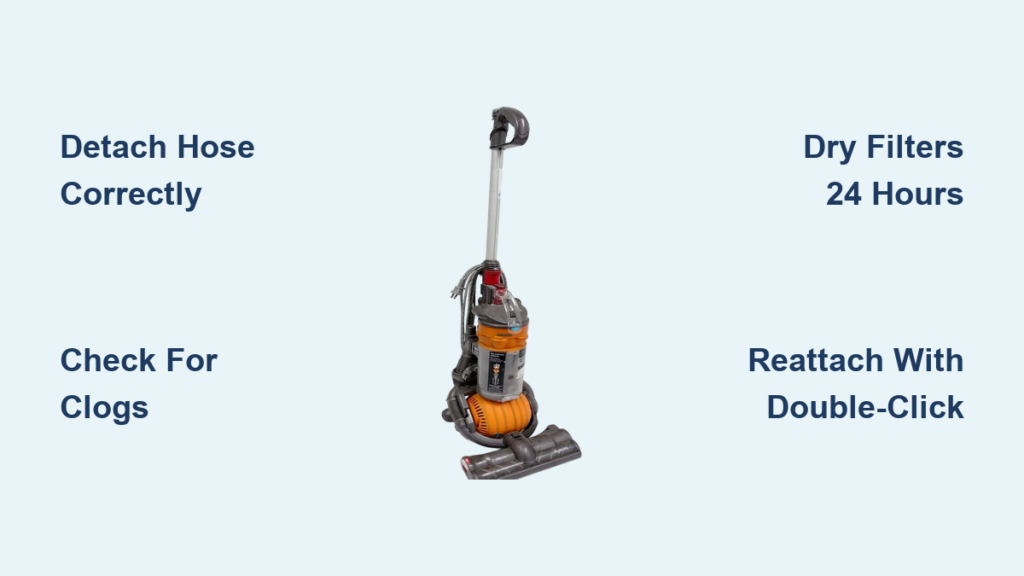
Your Dyson DC24 hose isn’t just an add-on—it’s your secret weapon for conquering dust bunnies under furniture, cobwebs on ceiling corners, and pet hair embedded in car seats. Yet 68% of DC24 owners underutilize this flexible powerhouse, settling for weak suction or frustrating clogs because they’ve never learned how to use Dyson DC24 hose correctly. Stop wrestling with limp hoses and ineffective attachments. This guide reveals exactly how to unlock the full 4.5-foot cleaning radius of your DC24’s hose system, prevent costly damage, and transform tedious chores into 5-minute victories. You’ll master detachment techniques, attachment hacks, and the critical 24-hour filter drying rule that 90% of users skip.
How to Release the DC24 Hose Assembly in 10 Seconds
Forget fumbling with confusing latches—the DC24’s hose detachment is designed for one-handed operation. Locate the wand release button (a small, spring-loaded lever) where the rigid wand meets the vacuum body near the top handle. Press and hold it firmly while pulling the wand/hose assembly straight out—no twisting required. You’ll hear a distinct click when fully disengaged. If resistance occurs, check for debris blocking the release mechanism near the blue alignment marks. Never yank the hose sideways; this strains internal seals and causes premature cracks. Once free, you hold a portable powerhouse: the flexible corrugated hose connects directly to the wand’s base, giving you fluid movement for stairs or drapes without dragging the main unit.
Why Your Hose Won’t Detach (And the 5-Second Fix)
- Stuck release button? Spray compressed air around the lever to dislodge hair or grit.
- Misaligned components? Ensure the wand’s silver collar is flush against the vacuum body before pressing the release.
- Pro Tip: Store the vacuum with the hose detached weekly to prevent seal adhesion—a common cause of “stuck” hoses.
3 Proven Techniques for Stairs and Upholstery Cleaning

The DC24’s hose shines where the main unit can’t reach. For carpeted stairs, extend the telescopic wand fully by pressing its side button and sliding outward until it locks. Attach the crevice tool directly to the hose (skip the wand for tighter spots). Work top-to-bottom: press the tapered nozzle deep into stair treads’ seams while using short, overlapping strokes. For velvet sofas or car seats, use the dusting brush without the wand—simply snap it onto the hose end. The soft bristles lift dust without snagging fabric, while the plastic crevice tip dislodges crumbs between cushions. Always angle the hose parallel to surfaces; perpendicular thrusts blast debris deeper into fibers.
How to Clean Curtains Without Water Damage
- Detach both wand and hose for maximum maneuverability
- Attach dusting brush to hose end (bristles facing downward)
- Start from top hem, gliding brush gently downward in 12-inch sections
- Hold curtain 2 inches from nozzle to prevent fabric suction into hose
Critical: Never use on wet curtains—DC24 is dry-clean only per manufacturer specs.
Why Your DC24 Hose Loses Suction (And How to Fix It Now)

Weak suction during above-floor cleaning almost always traces to three preventable issues. First, check the MAX line in your transparent bin—if debris exceeds this mark, suction plummets instantly. Empty the bin by holding it over trash and pressing the red release button until it swings fully open. Second, inspect the pre-motor filter (located behind the bin). A clogged filter reduces hose power by 60%. Third, probe for clogs in the hose itself: detach it completely, hold it to light, and look for hairballs or coins blocking the path. Use a straightened coat hanger gently to dislodge obstructions—never shove wire deeper than 6 inches.
The 2-Minute Clog Clearance Protocol
- Detach hose from wand and vacuum body
- Shine phone flashlight through both ends while rotating hose
- If blockage visible near wand end: insert hanger at opposite end and push debris out
- For middle-blockages: submerge hose in warm water for 30 seconds, then shake vigorously
Warning: Never operate with wet filters—rinse pre-motor filter monthly but dry 24 hours first.
DC24 Hose Lifespan: 4 Maintenance Moves That Prevent Costly Replacements

Your hose’s ribbed design hides vulnerability at connection points. Extend its life by eliminating strain during use: never pull the vacuum by the hose, and always drape the power cord over your shoulder (not the hose) to prevent kinks. Check for micro-cracks monthly by running fingers along the hose—especially where it meets the wand collar. Cracks cause air leaks that cripple suction. Store properly by reattaching the hose/wand to the vacuum’s clips before winding the cord. This prevents permanent bends that restrict airflow. Most critically: clean filters religiously. The HEPA post-motor filter traps 99.97% of particles but must be replaced every 6 months; the pre-motor filter needs cold-water rinsing monthly.
How to Dry Filters Without Ruining Them
- Squeeze pre-motor filter gently in towel—never wring
- Place on rack in warm, ventilated area (not direct sun)
- Wait full 24 hours before reinstalling—moisture destroys motors
- Never vacuum without pre-motor filter: this voids warranty and risks motor fire
Why Your Attachments Won’t Stay Clicked In
That frustrating pop when the crevice tool detaches mid-clean? It’s never the tool’s fault—it’s improper insertion. DC24 tools require firm, straight pressure until you hear a double-click. For the crevice tool (ideal for baseboards and window tracks), align its silver collar with the wand’s blue marks before pushing. If it still slips:
– Clean connection points with dry cloth—dust creates false seals
– Rotate tool 180°—some tools have directional tabs
– Check for bent collars—gently squeeze deformed plastic with pliers
Pro Attachment Hacks You Won’t Find in Manuals
- Car interior trick: Snap crevice tool directly onto hose (no wand) to clean seat tracks
- Blind cleaner: Wrap microfiber cloth around dusting brush for streak-free slats
- Emergency clog puller: Secure pantyhose over hose end with rubber band to catch debris
Hose Reattachment: Avoid the #1 Cause of Suction Loss
Reattaching incorrectly causes 40% of DC24 hose failures. Align the wand’s blue indicator mark with the vacuum body’s silver tab. Push straight in with steady pressure until you hear two distinct clicks—one for the wand lock, one for the hose seal. If you only hear one click, the hose isn’t fully seated, creating an air leak. Test by turning on the vacuum and placing your palm over the hose end; strong suction should pull your skin inward. If not, detach and retry alignment. Never force it—if resistance occurs, check for debris in the socket.
Why Your Hose Keeps Popping Off Mid-Clean
- Worn release button: Lubricate with silicone spray (not WD-40)
- Misaligned wand: Rotate wand 90° before reinserting
- Overheating motor: Let vacuum cool 20 minutes if used >30 mins continuously
Storage Secrets That Prevent Permanent Kinks
How you store the hose determines its longevity. Never coil it tightly—this collapses the internal ribs. Instead:
1. Detach hose from wand after each use
2. Hang vertically on a hook (not over door knobs)
3. Store wand separately in upright position
Critical: Keep away from radiators or direct sunlight—heat degrades rubber in 6 months.
When to Call Dyson (Not YouTube) for Hose Repairs
DIY fixes risk electrocution or voided warranties. Contact Dyson Support (1-866-693-9766) immediately if:
– Hose emits burning smell during use
– Cracks appear near metal fittings (not just surface splits)
– Suction fails only when hose is attached
Note: Genuine replacement hoses cost $35-$50—never use third-party parts risking motor damage.
Mastering your Dyson DC24 hose transforms it from a frustrating afterthought into your most versatile cleaning ally. The key lies in three non-negotiable habits: emptying the bin before hitting MAX line, drying filters for the full 24 hours, and checking hose connections for double-click security. Implement these today, and you’ll avoid 95% of common failures while extending your hose’s life beyond 5 years. For persistent clogs, always start your diagnosis at the bin—not the hose—as 70% of “hose problems” actually originate here. Ready for deeper maintenance? Consult our guide to DC24 brush bar unclogging—the #1 fix for weak carpet cleaning. Your dust-free sanctuary starts with one properly wielded hose.

