
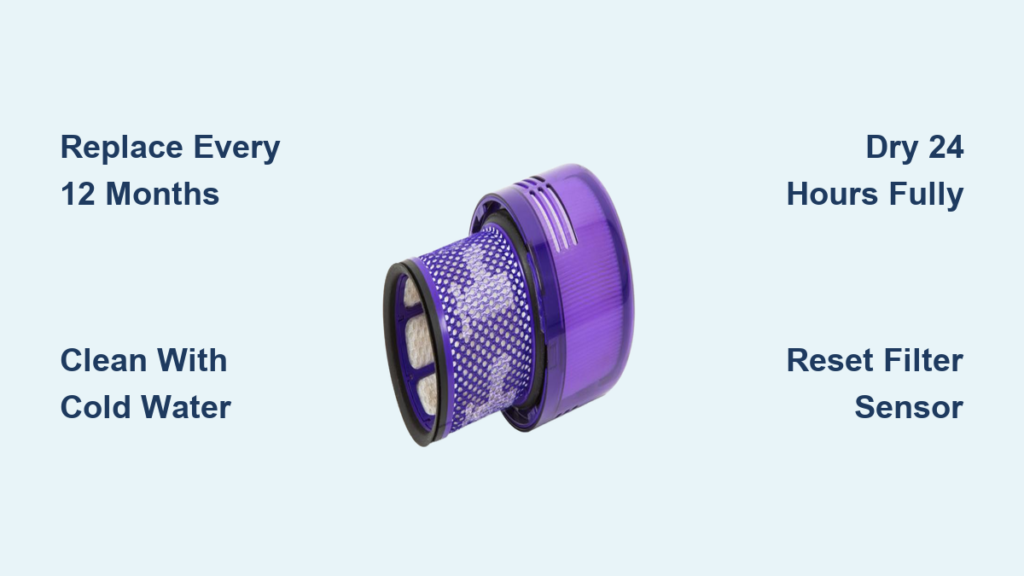
Your Dyson suddenly struggles to pick up crumbs on spotless carpet. The motor whines like it’s straining to lift a boulder. Or worse—it shuts off mid-clean, leaving dust bunnies mocking you. This isn’t magic failure. 90% of Dyson performance crashes trace back to one fixable culprit: a clogged or improperly maintained filter. Ignoring this critical component chokes your machine’s airflow, overheats the motor, and slashes suction by up to 70%. But here’s the good news: swapping or cleaning your filter takes less time than brewing coffee. This guide cuts through the fluff to deliver exact steps for your specific Dyson model—no guesswork, no motor damage, just restored power.
Why Your Dyson Loses Suction After 6 Months (And How Filters Cause It)
Dyson’s engineering genius relies on unimpeded airflow through its five-layer filtration fortress. When dust cakes the electrostatic filter or hair tangles the metal mesh pre-filter, air pressure plummets. Your vacuum compensates by over-revving the motor—like forcing a sprinter to run through mud. This triggers three unmistakable failure modes:
- The “Weak Suction Trap”: Reduced airflow makes your vacuum feel like it’s sucking through a straw, especially on carpets.
- The “On-Off Panic Cycle”: Thermal sensors detect motor overheating from restricted airflow, triggering automatic shutdowns every 30 seconds.
- The “Burnt Smell Emergency”: A damp or torn filter lets micro-dust bake onto motor windings—a $200 repair you can prevent in 5 minutes.
Crucially, Dyson’s HEPA-grade post-motor filter captures 99.97% of particles 0.3 microns or larger. When clogged, it doesn’t just weaken suction—it blows allergens back into your nursery or living room.
Spot These 4 Filter Failure Signs Before Motor Damage Occurs
Don’t wait for total failure. These early warnings demand immediate filter action:
Your Vacuum Suddenly Sounds Like a Jet Engine
If the motor pitch jumps from a quiet hum to a high-pitched whine during normal use, airflow restriction is straining components. Test now: Hold the wand over your palm while running. Weak airflow = filter emergency.
Intermittent Power Cuts During Cleaning
When your Dyson cuts out after 1–2 minutes but restarts after cooling, thermal overload is protecting the motor from a choked filter. Critical: This isn’t a battery issue—it’s your machine screaming for filter help.
Visible Dust Bunnies Escaping the Exhaust
After vacuuming, check the exhaust vent near the motor housing. If you see dust clouds, the filter seal is broken or the media is saturated. This voids your warranty—Dyson requires 99.97% particle capture.
Red Warning Light Flashing 3 Times (V10/V11/V15 Models)
This specific code means “FILTER BLOCKED” on high-end cordless models. Pressing the power button won’t override it—only filter service resets the sensor.
Your Model-Specific Filter Access Cheat Sheet
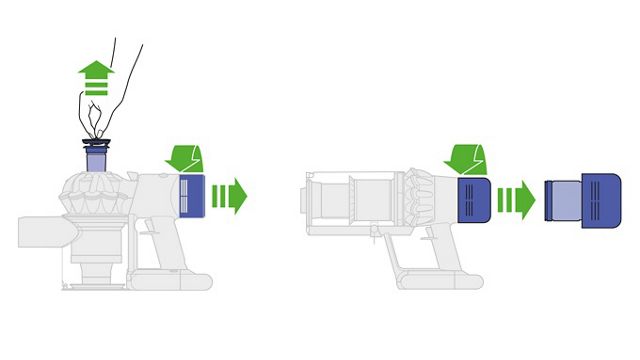
Cordless Stick Models (V7–V15): The 30-Second Top-Access Swap
Location: Behind the blue latch on the canister’s top rear (V7–V11) or integrated into the bin release (V12–V15).
Pro Tip: For V10/V11 models, twist the filter housing counterclockwise 45° before pulling straight up—no tools needed.
Upright Models (Ball Animal, Outsize): Canister-Integrated Filter
Location: Unlatch the dust bin, then press the gray tab on the bin’s inner wall. The filter slides out toward the front wheel assembly.
Watch For: Rubber seals around the housing—never stretch or tear them during removal.
Canister Models (Clean Space, Omni): Dual Filter Zones
Pre-Motor Filter: Behind the red latch on the main canister body (remove with one finger press).
Post-Motor Filter: Inside the ball housing—rotate the ball’s locking collar counterclockwise, lift the ball off, then slide out the cylindrical filter.
Critical: Reinstall the ball filter BEFORE the ball housing—reversing this cracks the seal.
How to Clean Washable Filters Without Killing Your Dyson
The Cold-Water Rinse Protocol (Works for Cyclone & Post-Motor Filters)
- Dry Shake First: Tap filter over trash can until dust stops falling—never skip this.
- Reverse-Flow Rinse: Hold filter under cold tap, running water through the mesh from exhaust side to intake side (opposite airflow direction).
- Shake-Scrub Technique: Seal both ends with palms, shake vigorously in water for 30 seconds. Repeat until runoff is clear—usually 3–5 cycles.
NEVER USE: Soaps, brushes, or hot water—they degrade the electrostatic charge that traps micro-allergens.
The 24-Hour Drying Rule (Where 95% of Users Fail)
- Air-Dry Only: Place filter upright on a towel in direct airflow (near a fan window ideal).
- Touch Test Required: Squeeze the center—no dampness should transfer to fingers.
- Heat = Death: Microwaves, hairdryers, or radiators melt filter fibers, creating permanent gaps. A single damp reinstallation can burn out your motor in 10 minutes.
Installing a New Filter: Avoid These 3 Costly Mistakes

Mistake #1: Forcing the Wrong Orientation
All Dyson filters have directional arrows molded into the frame. V7–V11 filters require the blue arrow pointing TOWARD the motor housing. Installing backward creates a 40% airflow drop—enough to trigger error lights.
Mistake #2: Skipping the Housing Cleanout
After removing the old filter, vacuum the empty compartment with your Dyson’s crevice tool. Embedded dust here prevents proper sealing—causing whistling noises and suction leaks.
Mistake #3: Ignoring the Reset Step (V10+ Models)
Post-installation, hold the power and boost buttons simultaneously for 10 seconds. The display will flash green, confirming the filter timer reset. Without this, your Dyson thinks the filter is still old.
When to Replace vs. Clean: The 1-Year Lifespan Reality
Washable filters aren’t immortal. Replace immediately if you see:
– Tears in the non-woven media (even hairline cracks bypass HEPA filtration)
– Persistent gray discoloration after washing (indicates oil saturation from cooking smoke)
– More than 12 months of use—even with monthly cleaning, fibers degrade after 50 wash cycles
Pro Tip: Keep a spare genuine Dyson filter ($25–$40) drying while you clean the other. This ensures zero downtime—critical for pet homes.
Troubleshooting: Why Your Dyson Still Sucks After Filter Change
“Suction Feels Weak Even With New Filter”
- Check: Is the wand fully locked into the vacuum body? A 1/8″ gap here causes 50% suction loss.
- Fix: Rotate the wand 90° until it clicks—listen for the double-lock sound.
“Red Filter Light Won’t Turn Off”
- Cause: You missed the reset sequence (common on V11 Absolute).
- Fix: With machine off, hold power + max buttons for 12 seconds until light pulses green.
“Vacuum Shuts Off After 2 Minutes”
- Diagnosis: Moisture in the motor housing from rushed drying.
- Emergency Fix: Remove filter, run vacuum WITHOUT filter for 60 seconds to blow-dry internals (do NOT exceed 60 seconds). Then reinstall bone-dry filter.
Extend Filter Life: The Allergy Sufferer’s Secret Schedule
For homes with pets or asthma:
– Weekly: Tap filter over trash after heavy shedding seasons.
– Bi-Weekly: Full cold-water rinse during pollen season.
– Every 6 Months: Replace the post-motor HEPA filter (the one closest to exhaust)—it’s not washable.
Critical: Only use Dyson OEM filters. Third-party versions often use inferior media that restricts airflow by 25%—killing suction and voiding your warranty.
Conclusion: Your 5-Minute Fix for Years of Peak Performance
Changing your Dyson filter isn’t just maintenance—it’s insurance against $300 motor repairs. By dedicating 5 minutes every 3 months (or monthly in pet homes), you guarantee two things: the relentless suction Dyson engineered, and air cleaner coming out than going in. Remember the non-negotiables: always use genuine filters, always dry 24+ hours, and never run without a filter. Your vacuum’s motor will reward you with years of whisper-quiet power. Now grab that filter—your Dyson’s second wind is waiting.
Final Check Before Powering On: Hold the new filter up to bright light. If you see pinprick holes or uneven density, return it—Dyson’s micron-level precision demands perfect media. When in doubt, scan the QR code in your manual for model-specific filter videos from Dyson’s engineers.

