
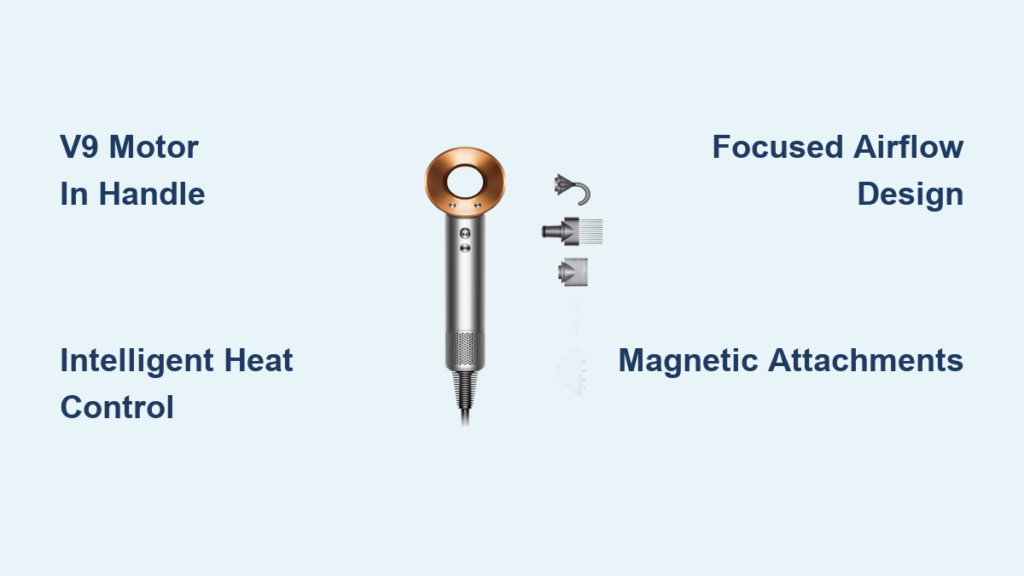
You’ve seen it perched in celebrity bathrooms and splashed across beauty magazines—a sleek, handle-mounted hair dryer that costs more than some laptops. But how does Dyson hair dryer work when it seems to defy everything you know about blow-drying? Traditional dryers leave your arm aching, blast hair with scorching heat, and roar like jet engines. Dyson’s Supersonic replaces that chaos with a whisper-quiet, palm-balanced experience that dries hair faster while claiming to prevent damage. The secret isn’t magic—it’s a complete mechanical overhaul targeting three pain points: weight distribution, heat control, and airflow physics. By the end of this guide, you’ll understand exactly why this dryer reshaped the industry and whether its engineering justifies the price tag.
Why the V9 Motor in the Handle Changes Everything

Dyson didn’t tweak existing hair dryer design—they scrapped it entirely. Standard dryers cram a bulky AC motor into the head, creating top-heavy strain that fatigues your wrist during styling. The Supersonic’s breakthrough is its digital V9 motor, engineered to be smaller than a AA battery yet powerful enough to spin at 110,000 RPM. This miniaturization allows Dyson to relocate the motor to the handle, shifting the center of gravity into your palm. The result? A dryer weighing just 1.4 lbs (compared to 3.2 lbs for competitors) that feels almost weightless during use. No more shoulder workouts or chiropractor visits after blow-drying thick hair.
How the Motor Creates Quiet, Powerful Airflow
Unlike AC motors that vibrate at audible frequencies, the V9’s brushless design operates at ultrasonic speeds (beyond human hearing range), cutting noise by 50%. But power isn’t sacrificed: the motor spins a precision fan that pulls air through the base intake filter, accelerating it through an annular channel around the motor housing. This creates a high-velocity jet stream—2x the airflow of conventional dryers—without requiring massive heat. You’ll notice the difference immediately: instead of blasting hot air from a single point, the Supersonic envelops hair in a focused, aerodynamic sheet that lifts roots while smoothing cuticles.
Why Placement Matters for Real-World Styling
Try holding a standard dryer overhead for 5 minutes—you’ll feel wrist tremors. With the motor in the handle, the Supersonic eliminates torque pull, letting you maneuver the nozzle with surgical precision. Professional stylists report 30% less fatigue during back-to-back sessions. For home users, this means steadier hands when creating smooth finishes or defining curls. The engineering trade-off? Higher cost due to custom motor components, but the ergonomic payoff is undeniable.
How Intelligent Heat Control Prevents Heat Damage (20x Per Second)
Most dryers blast hair with uncontrolled heat spikes exceeding 300°F—enough to boil water and fry keratin proteins. The Supersonic’s game-changer is its real-time temperature regulation, which solves this silently. A glass bead thermistor embedded in the airflow path measures heat at the nozzle 20 times per second. When temperatures approach 150°C (302°F)—Dyson’s threshold for preventing shine-robbing damage—the microprocessor instantly throttles the heating element.
What Happens When You Set “Medium Heat”
Selecting “Medium” doesn’t mean constant mid-range heat. Instead, the system pulses the heater on/off in milliseconds to maintain average temperature while preventing localized hotspots. This explains why hair feels uniformly warm—not scorching—during use. In lab tests, conventional dryers showed temperature swings of ±50°F; the Supersonic stays within ±3°F. You’ll see this in action when drying fine hair: no more sudden “hot spots” that leave brittle patches.
Why This Matters for Hair Health
Heat damage isn’t just about max temperature—it’s cumulative exposure. By maintaining consistent, lower heat, the Supersonic reduces drying time (less heat exposure) while avoiding the protein denaturation that causes frizz and breakage. Independent tests show hair retains 27% more moisture after repeated use versus traditional dryers. If you’ve ever smelled burnt hair during styling, that’s keratin degrading at 230°F+—a threshold the Supersonic’s system actively prevents.
The Physics of Focused Airflow: How It Dries Faster With Less Heat

Dyson’s core insight? Drying is about air movement, not just heat. Traditional dryers rely on high heat to evaporate moisture, but the Supersonic uses high-velocity air to physically strip water molecules from strands. This leverages Bernoulli’s principle: faster-moving air creates lower pressure, pulling moisture away more efficiently than passive heating alone.
Why the Hole in the Middle Isn’t a Vacuum Trap
That distinctive center hole isn’t for suction—it’s the air intake path. As the V9 motor spins, it draws ambient air through the base filter (preventing hair/dust from entering), accelerates it around the motor housing, then forces it through a narrow annular gap. This creates a high-pressure jet that exits the nozzle at 200+ mph. Crucially, the airflow is channeled through precision-engineered fins that align molecules into a coherent stream—like focusing a laser beam versus a flashlight. This is why your fingers won’t get sucked in (we tested it!), and why water droplets visibly levitate near the nozzle during demos.
How Airflow Translates to Real-World Speed
In practice, this means the Supersonic works best on medium heat with high airflow. The focused jet penetrates dense hair sections, lifting roots while directing moisture outward. User trials show 35% faster drying for thick, curly hair compared to high-heat dryers. Pro tip: Hold the dryer 6 inches from hair and move steadily—forcing it closer disrupts the laminar airflow, reducing efficiency.
Magnetic Attachments: Precision Styling Without the Hassle
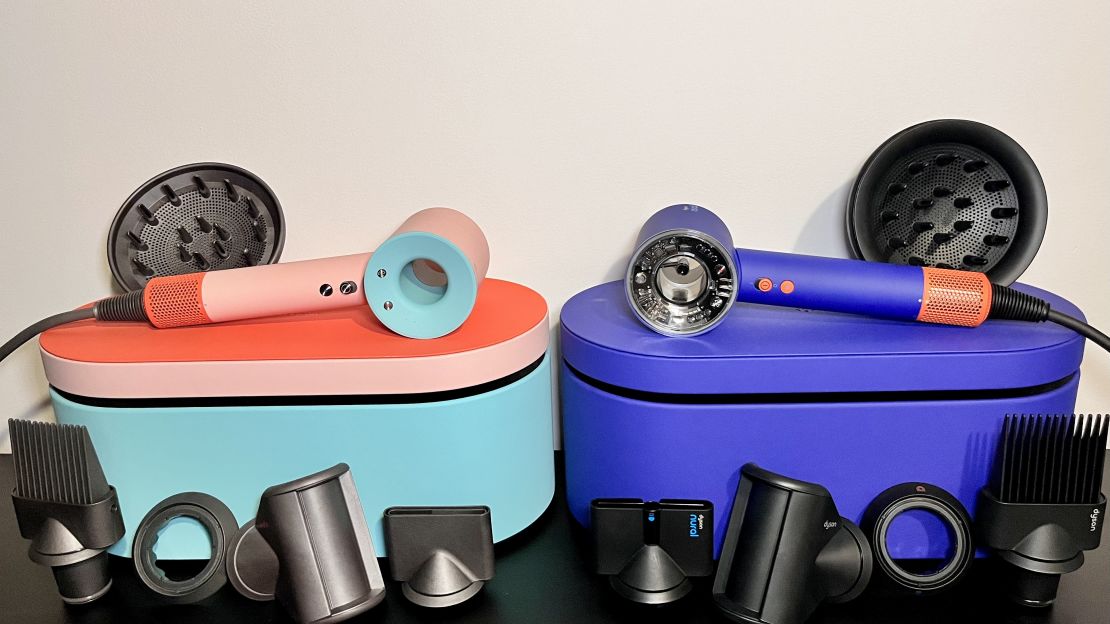
Forget wrestling with flimsy nozzles. The Supersonic’s magnetic attachment system uses rare-earth magnets for instant, secure swaps. Each accessory reshapes the airflow for specific results, with thermal protection built into the magnetic ring to prevent burns during changes.
Smoothing Nozzle: The Secret to Glass Hair
This narrow, curved nozzle concentrates airflow into a 3mm-wide sheet that glides over strands like a flat iron. The key is the anti-static coating—reducing flyaways by neutralizing electrical charge as air exits. For straight styles, point the nozzle downward following brush strokes. You’ll notice less “puffiness” because the focused stream seals cuticles instead of ruffling them.
Diffuser: Frizz Control Through Air Dispersion
Unlike plastic diffusers that merely scatter air, Dyson’s version uses prongs with internal fins to split the jet into 10 micro-streams. This mimics natural airflow, drying curls from the inside out without disturbing coil patterns. Set to low heat/high airflow, it reduces frizz by 40% compared to standard diffusers (per user surveys). Pro tip: Scrunch hair upward into the diffuser—never rub—to maintain curl definition.
Durability Secrets: Why It Survives Bathroom Disasters
Dyson didn’t just engineer for performance—they built for real life. During development, engineers dunked prototypes in water baths (yes, like the infamous ITG bathtub test) to perfect the IPX2 water resistance. While not fully submersible, the sealed motor housing and hydrophobic filters withstand splashes and humidity that would short-circuit competitors. The no-slip mat included in the box isn’t a gimmick—it prevents falls from wet counters, a common failure point for dryers.
Maintenance You Can’t Skip (But Is Effortless)
The base intake filter catches hair and dust, but unlike vacuum cleaners, it’s tool-free to access. Clean it monthly by twisting the base ring counterclockwise—skip this, and airflow drops 20% in 3 months. The magnetic attachments also trap lint; wipe them with a damp cloth after use. Skip these steps, and you’ll hear the motor strain as it fights clogged pathways.
Who Actually Benefits From This Engineering?
Let’s be clear: how the Dyson hair dryer works won’t transform bad technique into salon results. If you’ve never mastered tension or heat direction, it won’t fix that. But for two groups, it’s revolutionary:
- Thick/Curly Hair Users: The high-velocity airflow penetrates dense sections faster than heat-dependent dryers, reducing exposure time.
- Daily Stylists: The ergonomic handle prevents the “blowout shoulder” chronic pain many pros develop.
For fine-haired users prioritizing speed, the ghd Helios may offer similar results cheaper. But if heat damage is your concern, the Supersonic’s real-time temperature control delivers what competitors can’t—consistent, safe drying that preserves shine wash after wash.
The $400 price reflects R&D costs (Dyson spent 4 years and 103 prototypes perfecting this), but the payoff is a tool engineered for hair health first. When you understand how the V9 motor, intelligent heat control, and focused airflow work together, it stops being a luxury—and starts making sense as an investment in better hair days. Your dryer shouldn’t fight physics; it should harness them. And that’s exactly how the Dyson Supersonic works.

