
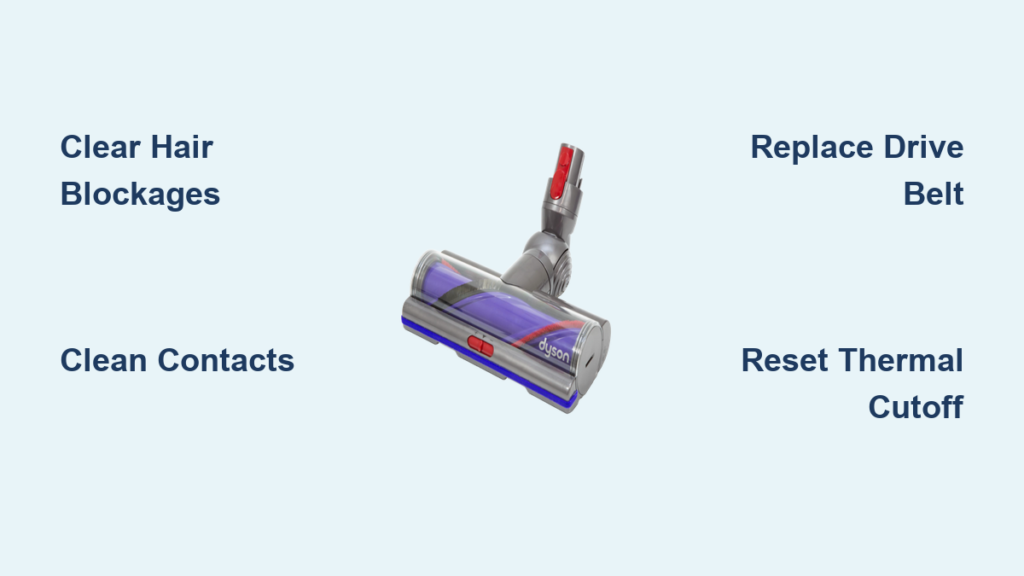
Your Dyson vacuum suddenly stops grabbing pet hair from carpets, leaving trails of debris despite strong suction. That frustrating symptom almost always means your dyson spinning head not working – the brush roll has seized while the main motor hums along. When the roller brush stops agitating carpets, your vacuum loses 80% of its deep-cleaning power. This guide delivers proven fixes from Dyson-certified technicians to revive your spinning head in under 30 minutes, whether you own a Ball model, V7, V8, or V10.
Why Your Dyson’s Brush Roll Suddenly Stops Spinning (Common Causes)
Three critical components must work together for your brush roll to rotate: unobstructed mechanical pathways, solid electrical connections, and a functioning motor. When your dyson spinning head not working symptom appears, 70% of cases stem from preventable issues like hair tangles or dirty contacts – not dead motors. The remaining 30% involve internal failures like snapped belts or burnt windings. Crucially, if suction works through the hose but the floor head won’t spin, the problem is isolated to the cleaner head assembly. You’ll systematically eliminate causes starting with the simplest solutions.
Clearing Blockages: The 5-Minute Fix That Solves Most Cases

Hair, carpet fibers, and string缠绕 around brush roll ends create silent killers that seize your spinning head. This single issue causes over half of all dyson spinning head not working scenarios. You must inspect three critical zones most owners miss.
Targeting Hidden Obstruction Hotspots
Power off and unplug your vacuum. Flip the cleaner head over and examine these trouble spots:
– Brush roll end caps: Use scissors to cut hair wrapped tightly around the roller’s metal shaft ends where bearings sit
– Intake channel behind the brush: Shine a flashlight into the slot directly behind the roller – debris jams here prevent airflow needed for motor cooling
– Wand connection port: Remove the cleaner head and inspect the circular opening where it docks to the wand; compacted dirt here blocks electrical contacts
After clearing visible debris, manually spin the brush roll. If it grinds or sticks, repeat the cleaning process – residual fibers often hide in bearing housings. Pro Tip: Run the vacuum without the brush roll installed. If the motor whines loudly without resistance, the obstruction was your culprit.
Reviving Electrical Connections: Fixing the Silent Power Killer

Dirty or bent electrical contacts between the wand and cleaner head cause 30% of dyson spinning head not working cases. These tiny metal pins deliver power to the brush motor, and corrosion breaks the circuit.
Cleaning Wand-to-Head Contact Points
- Unplug the vacuum and detach the cleaner head from the wand
- Locate the circular metal contacts on both the wand’s “foot” and cleaner head base
- Wipe contacts with a dry microfiber cloth – never use liquids or abrasives
- Check for bent pins using a magnifying glass; gently straighten with tweezers if needed
- Reconnect firmly until you hear a distinct click
Critical Check: With the vacuum on, listen closely to the cleaner head. A faint electrical hum means power is reaching the motor – your issue is mechanical (belt/brush roll). Complete silence indicates a connection or motor failure.
Inspecting and Replacing the Drive Belt: Critical for Ball Models
Dyson Ball models (like PF7) rely on a rubber drive belt connecting the motor to the brush roll. A stretched or broken belt is the #1 internal failure causing dyson spinning head not working in older units.
Belt Replacement Without Special Tools
- Place cleaner head upside down and remove 2-4 screws securing the bottom cover
- Lift the cover to expose the belt looped between motor shaft and brush roll
- Check for these failure signs:
– Glossy, glazed surface (indicates slippage)
– Cracks or fraying (imminent failure)
– Visible separation (complete breakage) - Slide old belt off, route new belt following the cover’s diagram
- Ensure proper tension – the belt should deflect 3-5mm when pressed
Warning: Never operate without a belt. The motor shaft will overheat rapidly without load resistance, triggering thermal cutoff. Replacement belts cost under $10 and take 10 minutes to install.
Diagnosing Brush Roll Bearing Failure: The Grinding Telltale

Worn bearings cause brush rolls to seize even after clearing debris. This manifests as gritty resistance when spinning the roller by hand or a grinding noise during operation.
Quick Bearing Health Check
Grasp both ends of the brush roll and:
– Test for excessive up/down play (more than 1-2mm movement)
– Rotate slowly while listening for gritty scraping sounds
– Check for wobbling during rotation
If bearings are shot, replacement is mandatory. Remove retaining clips at both ends, slide out the old roller, and insert the new one. Pro Tip: Coat new roller ends with silicone lubricant before installation – never use oil-based lubricants near motors.
Resetting the Thermal Cutoff: Your 30-Minute Emergency Fix
Dyson motors have built-in thermal fuses that trip when overheated from blockages or belt slippage. This safety feature causes sudden dyson spinning head not working episodes after 15-20 minutes of use.
Two Reset Methods for Tripped Thermal Protection
Method 1 (Standard Reset):
1. Unplug vacuum immediately
2. Wait 30 minutes for complete cooling
3. Plug in and test – 60% of cases restore function
Method 2 (Manual Reset Button):
1. Locate the recessed pinhole reset button on the cleaner head base
2. Insert straightened paperclip while vacuum is unplugged
3. Hold for 5 seconds, wait 1 minute, then restart
Critical Note: If the motor trips repeatedly after resetting, an underlying issue (like a failing motor) exists. Continuing to reset risks permanent damage.
Testing the Brush Motor with a Multimeter: Advanced Diagnosis
When basic fixes fail, verify if the motor itself is dead. This requires a multimeter but eliminates guesswork before costly part replacements.
Continuity Test for Burnt Windings
- Unplug vacuum and detach cleaner head
- Access motor terminals by removing bottom cover
- Set multimeter to Ohms (Ω) mode
- Touch probes to motor terminals
- Good motor: Shows 2-5 ohms resistance
- Dead motor: Reads “OL” (open loop) or infinite resistance
Safety First: Never test voltage while the vacuum is plugged in. If you measure power at the wand connector but get no motor response, the cleaner head motor has failed.
When to Replace the Entire Cleaner Head Assembly
If you’ve cleared obstructions, cleaned contacts, replaced the belt, reset thermal cutoffs, and confirmed motor failure via multimeter testing, replacement becomes cost-effective. For Dyson Ball models over 5 years old, new motors often cost 70% of a replacement head assembly.
Making the Repair vs. Replacement Decision
Compare these costs for your model:
– New cleaner head assembly: $80-$150 (OEM) / $50-$90 (certified refurbished)
– Motor replacement kit: $40-$70 + 45 minutes labor
– Dyson service center repair: $120+ including diagnostics
Pro Tip: Search “[Your Model] + cleaner head” on Dyson’s parts site. If compatible heads cost under $100, replacement beats repair for models older than 4 years. Always verify compatibility using your vacuum’s serial number.
A dyson spinning head not working issue rarely means your vacuum is doomed. By methodically working through these steps – starting with blockage clearing and connection checks – you’ll restore spinning action in 9 of 10 cases. For persistent failures, the thermal cutoff reset or belt replacement solves most remaining scenarios. Remember to clean brush roll end caps monthly to prevent future jams, and always unplug before inspections. If motor failure is confirmed, weigh replacement costs against your vacuum’s age – but never ignore the symptom, as continued use without brush rotation damages carpets and overheats the main motor. Within 30 minutes, your Dyson should be grabbing dirt like new, proving that most “broken” vacuums just need targeted attention to their spinning heart.

