
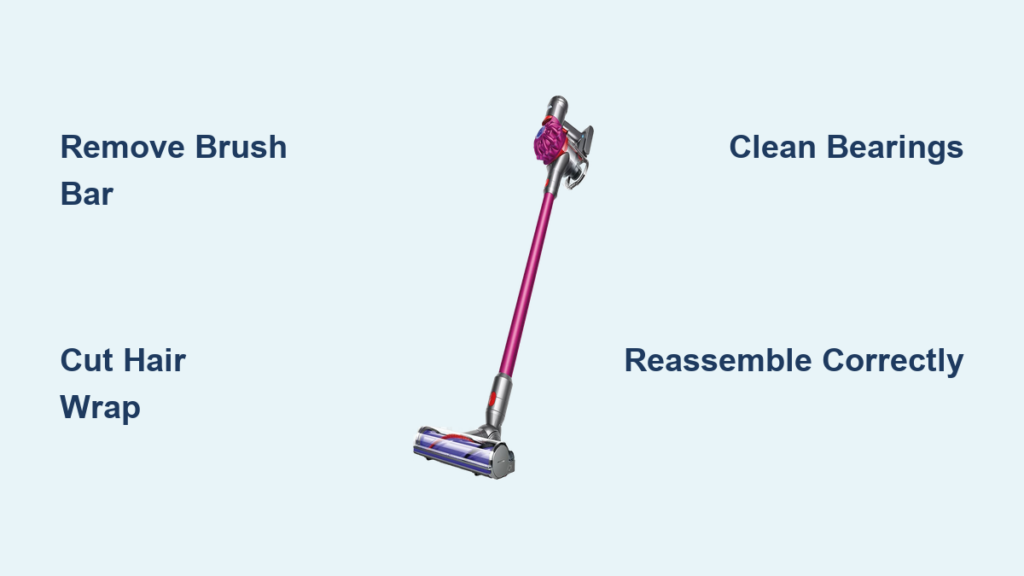
You’re vacuuming your living room when suddenly the Dyson V7’s brush bar stops spinning. The suction feels weak, leaving trails of pet hair and debris behind. That familiar frustration hits – your once-powerful vacuum now struggles on bare floors. This happens because hair, string, and dust clog your Motorhead’s brush bar and air pathways, choking suction and straining the motor. Left uncleaned, these blockages can permanently damage your vacuum’s performance. In this guide, you’ll discover exactly how to clean your Dyson V7 Motorhead thoroughly, restoring like-new suction without professional help. We’ll cover every critical step from disassembly to reassembly, including pro techniques for stubborn hair wrap and filter maintenance that most users miss.
Why Hair Wrap Kills Your Dyson V7 Suction (and How to Fix It)

When hair and fibers wrap around your Motorhead’s brush bar, they create a physical barrier that stops the roller from spinning. This forces the motor to work harder while reducing airflow through the vacuum’s system. The result? Weak suction on carpets, poor debris pickup on hard floors, and that alarming burning smell when the motor overheats. You’ll know it’s time for cleaning when you notice the brush bar visibly tangled, hear unusual grinding noises during use, or see reduced pickup performance even after emptying the bin. Ignoring these signs leads to permanent motor damage – but the good news is that 90% of suction problems can be solved with proper Motorhead cleaning. This isn’t just maintenance; it’s essential surgery for your vacuum’s respiratory system.
Critical Safety Steps Before Cleaning Your Dyson V7
Never skip these precautions before touching your vacuum. Start by ensuring your Dyson V7 is completely powered off and unplugged from its charger – a crucial step many cordless vacuum owners overlook. Unlike plug-in models, residual battery charge can accidentally activate the motor during cleaning, causing serious injury from the spinning brush bar. Work on a clean, well-lit surface like your kitchen counter where you won’t lose small parts. Keep children and pets away from your workspace since the five tiny screws securing the Motorhead base plate can easily get lost. Finally, gather your tools beforehand: you’ll need a coin or flat-head screwdriver, seam ripper or small scissors, soft toothbrush, and microfiber cloth. Rushing this preparation leads to stripped screws or damaged components.
How to Safely Remove the Motorhead From Your V7
- Press the red wand release button firmly while holding the vacuum body steady
- Slide the Motorhead straight off the wand with a gentle twisting motion
- Turn the cleaner head upside down to access the base plate screws
- Critical check: Verify the vacuum is OFF by pressing the trigger – no response means it’s safe to proceed
Emptying and Cleaning the Clear Bin: Daily Maintenance You Can’t Skip
A full bin creates immediate suction loss, but residual dust inside the cyclone assembly causes long-term damage. Start by emptying over a trash can: press the red bin release tab while holding the cyclone handle, then flip the assembly upside down and press the top lever to open the bottom door. For deep cleaning, detach the clear bin by pressing the cyclone release button and separate it from the cyclone section. Rinse both components under cold running water – never use hot water as it warps the plastic. Pay special attention to the cyclone’s internal channels where fine dust accumulates. Shake off excess water and dry completely with a microfiber cloth before air-drying for 24 hours. Never reassemble while damp – moisture causes mold growth that creates foul odors and clogs filters.
Why Your Dyson V7 Filter Needs Monthly Cleaning
The post-motor filter sits directly below the cyclone in your clear bin assembly and traps microscopic particles. When clogged, it chokes airflow and overheats the motor. To access it, twist the filter counterclockwise after removing the cyclone assembly. Wash it in cold water only – soap residues clog the foam pores permanently. Gently squeeze (never wring) to remove water, then air-dry in a warm spot for 48 hours. Critical mistake alert: Many users reinstall damp filters thinking “a little moisture is fine.” This causes immediate suction loss and promotes mold growth inside the vacuum body. Always verify the filter is bone-dry by pinching the foam – no dark spots should remain.
Removing the Motorhead Base Plate Without Stripped Screws
Five tiny screws secure the base plate covering your brush bar. Using the wrong tool here causes irreversible damage. Insert a coin edge or flat-head screwdriver into the screw slots – never use pliers that slip and scratch the housing. Turn screws counterclockwise with steady, light pressure. If resistance occurs, stop immediately; forcing it strips the plastic threads. Place screws on a magnetic mat or tape them to cardboard to prevent loss. Once removed, gently lift the base plate straight up – don’t pry it, as the plastic tabs are fragile. You’ll now see the tangled brush bar assembly. Pro tip: Take a photo of the screw layout before removal – this prevents misalignment during reassembly.
Cutting Hair Wrap From the Brush Bar Safely

Hair wrap is the #1 cause of Motorhead failure, but improper removal damages bearings. Start at the brush bar ends where hair anchors tightly to the axles. Use a seam ripper (included with most V7 kits) to slice through strands – scissors risk cutting bristles. Work toward the center with short, upward strokes while rotating the brush bar. Never pull hair forcefully; this misaligns the roller. For stubborn fibers, dip the toothbrush in rubbing alcohol to dissolve sticky residues. After clearing major tangles, spin the brush bar manually to check for smooth rotation. If it catches, recheck axle ends for hidden strands. Warning: Never use lubricants on bearings – they attract more dust.
Cleaning Motorhead Bearings and Air Pathways Thoroughly

With the brush bar removed, inspect the housing interior for compacted debris. Use the toothbrush to dislodge dust from the small bearing sockets at each end – this is where most suction loss originates. Pay special attention to the V-shaped air channel along the soleplate’s leading edge; pet hair packs tightly here. Wipe the entire housing with a slightly damp microfiber cloth, focusing on the rubber seals that maintain air pressure. For the soleplate (floor-contact surface), clean the central brush bar opening with a cotton swab dipped in alcohol. Critical step: Verify all air pathways are clear by holding the housing up to light – you should see unobstructed channels from front to back.
Reassembling Your Dyson V7 Motorhead Without Costly Mistakes
Misaligned components cause immediate re-clogging. First, reinstall the brush bar ensuring it sits flush in both bearing sockets – it should spin freely with finger pressure. Place the base plate over the assembly, aligning all tabs before pressing down firmly. Hand-tighten screws in a star pattern (opposite corners sequentially) to prevent warping. Never use tools for final tightening – snug by hand is sufficient. Reattach the Motorhead to the wand with a firm push until you hear the distinct double-click. Before testing, verify the brush bar spins freely when held upright. Common error: Skipping the dry-test leads to re-disassembly when you discover misalignment during use.
Testing Suction and Brush Bar Performance Post-Cleaning
Don’t just plug in and vacuum – perform these critical checks first. Hold the vacuum upright and trigger the motor while watching the brush bar. It should spin instantly at full speed with no hesitation. Place your palm over the soleplate intake; you should feel strong suction within 2 seconds of activation. For the ultimate test, vacuum a small pile of cereal on hardwood – it should lift completely in one pass. If suction feels weak, immediately check: 1) Filter is fully dry and locked in place 2) Bin is properly seated 3) No debris remains in the wand connector. Pro tip: Run the vacuum for 2 full minutes after cleaning to burn off any residual alcohol from the bearings.
Creating Your Dyson V7 Motorhead Cleaning Schedule
Preventative maintenance beats emergency repairs. After pet grooming sessions, perform a 2-minute brush bar check: detach the Motorhead and spin the roller by hand – if resistance occurs, clean immediately. For households with long hair or pets, deep clean the Motorhead every 2 weeks. In low-hair environments, monthly cleaning suffices. Always wash the filter every 3 months (or when it turns gray), and never operate without it. Store your V7 on its wall dock with the Motorhead detached to prevent dust settling in the brush bar. Key insight: Consistent 5-minute cleanings extend Motorhead life by 3+ years compared to waiting for complete failure.
Restoring your Dyson V7’s suction takes less time than brewing coffee – just 15 focused minutes every few weeks prevents expensive repairs. By mastering these Motorhead cleaning techniques, you’ll maintain showroom-level performance from your vacuum for years. Remember the golden rule: when in doubt about reassembly, consult Dyson’s official video guides rather than forcing components. Now that your Motorhead spins freely, maximize results by learning how to clean your V7’s wand filters – the next critical step in sustaining peak suction. Your floors (and your back) will thank you every time you power up that satisfyingly strong vacuum.

