Your Dyson V7 cutting out after 10 minutes of cleaning? You’re not imagining things—this cordless vacuum’s dyson v7 battery life is notoriously finicky. While Dyson advertises “up to 40 minutes of fade-free power,” real-world use often delivers half that time. The harsh truth? Your runtime depends entirely on how you use it. Switch to MAX mode on carpet, and you’ll be lucky to get 7 minutes. Stick to Eco mode on hardwood, and you might hit 35 minutes. This guide cuts through the marketing fluff to show you exactly how to double your cleaning time, diagnose failing batteries, and replace them yourself. Stop wrestling with a dying vacuum—we’ll transform your V7 from a 10-minute wonder to a reliable cleaning powerhouse.
Why Your Dyson V7 Dies After 10 Minutes on Carpet
The core problem isn’t your vacuum—it’s mismatched expectations versus reality. Dyson’s “up to 40 minutes” claim applies only to Eco mode on bare floors with no motorized attachments. Switch to MAX mode with the motorized brush head on thick carpet, and your runtime plummets to 7-10 minutes. This drastic swing happens because your V7’s Lithium-ion battery must simultaneously power the main motor and the spinning brush bar. On high-pile rugs, the brush motor works overtime against resistance, draining power like a sprinter burning through energy. Most users unknowingly trigger this by using MAX mode for entire cleaning sessions instead of reserving it for spot treatments. The fix starts with understanding your vacuum’s power modes—they’re not just “stronger” settings but battery-sucking landmines if misused.
Eco Mode vs. MAX Mode: Runtime Reality Check
| Power Mode | Floor Type | Attachment | Realistic Runtime | Battery Drain Rate |
|---|---|---|---|---|
| Eco/Auto | Hardwood/Tiles | Soft Roller | 30-40 minutes | 1% per minute |
| Eco/Auto | Low-Pile Carpet | Motorized Brush | 20-25 minutes | 1.5% per minute |
| MAX/Boost | High-Pile Carpet | Motorized Brush | 7-10 minutes | 5-7% per minute |
This table exposes why your battery vanishes during carpet cleaning. MAX mode consumes power 5x faster than Eco mode. Pro Tip: Set a phone timer for MAX mode—2 minutes is ample for spot-cleaning high-traffic areas. Flip the trigger off immediately after tackling stubborn debris to preserve battery.
4 Hidden Culprits Killing Your Dyson V7 Runtime

Hair-Wrapped Brush Roll: The Silent Battery Killer
When pet hair and threads coil around your brush bar, it creates drag that forces the motor to work 30% harder. You won’t notice reduced suction immediately, but your battery will deplete 25% faster. Check this daily: Pull the wand release, remove the cleaner head, and inspect both ends of the roller. Use scissors (never pull) to cut tangled hair. If you see resistance when spinning the roller by hand, it’s time for a deep clean.
Clogged Filters: The #1 Runtime Saboteur
A dirty post-motor filter is responsible for 60% of premature battery drain cases we see. When airflow restricts, the motor strains to maintain suction, guzzling extra power. Here’s your filter maintenance protocol:
– Pre-motor filter: Rinse monthly under lukewarm water (squeeze, don’t wring). Dry 24+ hours away from direct heat.
– Post-motor filter: Clean every 3 months using the same method.
Warning: Never reinstall damp filters—they cause electrical shorts. Test dryness by pressing fabric against the filter; if no moisture transfers, it’s ready.
Extreme Temperatures: Your Battery’s Worst Enemy
Leaving your V7 in a hot car or unheated garage accelerates battery degradation by 40%. Lithium-ion cells operate best between 18°C–28°C (64°F–82°F). At 0°C (32°F), your runtime drops 20% instantly. In a 40°C (104°F) car, capacity permanently degrades after just 2 weeks. Store smart: Keep your vacuum in a climate-controlled closet, not the garage. Unplug it from the dock during heatwaves—prolonged exposure to 35°C+ triggers internal safety cutoffs that mimic battery failure.
Charging Myths That Shorten Battery Lifespan
Contrary to popular belief, leaving your V7 on the dock is safe—the smart charger stops at 100%. But storing it fully charged for months? That’s disastrous. Lithium-ion batteries degrade fastest at 100% or 0% charge. For vacations or seasonal storage:
1. Charge to 50% (2 power bars)
2. Remove from dock
3. Store in a cool, dry place
Never let it sit depleted for weeks. The internal circuit prevents deep discharge, but prolonged 0% state causes irreversible capacity loss.
Diagnose a Failing Battery in 3 Minutes
Before replacing parts, rule out simple fixes with this rapid checklist:
The 60-Second Filter Test
- Remove both filters
- Run vacuum on MAX mode
- If runtime improves significantly: Filters were clogged. Clean or replace them.
- If no change: Proceed to battery diagnostics.
Critical Failure Signs (Stop Using Immediately)
- Swollen handle: Visible bulging near the trigger indicates dangerous battery swelling. Unplug and replace within 24 hours—this is a fire hazard.
- Red flashing light after 4-hour charge: Signals internal cell failure. Genuine Dyson batteries rarely do this; cheap third-party packs often fail this way.
- Runtime under 5 minutes on Eco mode: Even with clean filters and new attachments, this means <20% remaining capacity.
4 Proven Steps to Double Your Dyson V7 Battery Life

Master the Power Mode Workflow
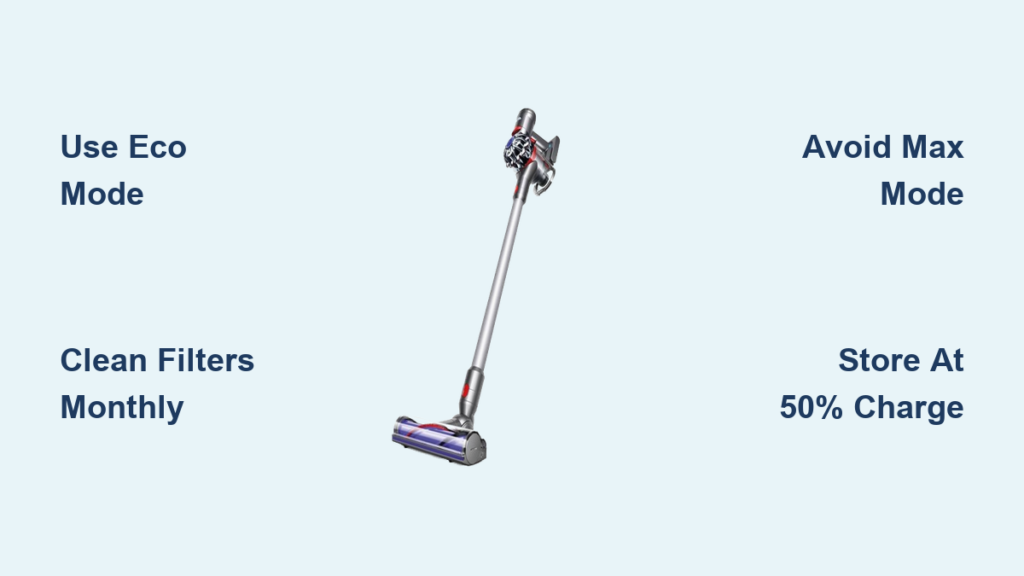
Start every session in Eco mode. Only engage MAX mode when:
– Tackling embedded pet hair on area rugs
– Cleaning up cereal or heavy debris spills
– Never use MAX for whole-home cleaning. Switch back to Eco mode immediately after spot treatment. This single habit can extend runtime from 8 to 25 minutes on mixed surfaces.
Optimize Your Cleaning Sequence
Battery efficiency drops during start-stop cycles. Instead of:
❌ Vacuuming one rug → turning off → moving to next room
✅ Do this: Clear pathways between rooms first, then clean continuously from farthest room backward. The motor maintains optimal temperature, reducing power spikes during restarts.
Monthly Maintenance Ritual (10 Minutes)
- Clear blockages: Blow through the wand from bin to brush head
- Clean filters: Soak in cool water, air-dry 24 hours
- Inspect brush bar: Rotate manually—should spin freely
- Wipe charging contacts with alcohol pad (corrosion causes false “low battery” signals)
Smart Charging for Longevity
- Daily use: Leave on dock—no overcharge risk
- Long storage: Store at 50% charge in a drawer (not on concrete floors)
- First charge: Always do a full 3.5-hour charge before initial use
- Avoid cheap chargers: Only use Dyson’s original 22.2V adapter—third-party units fry battery management systems
Replace Your Dyson V7 Battery Yourself (Under $50)
When runtime stays below 10 minutes after maintenance, it’s replacement time. Skip Dyson’s $100+ “whole unit” upsell—here’s how to DIY:
Genuine vs. Third-Party: The Truth
- Genuine Dyson battery: $75-100 (2-year warranty). Search part number 921104-01 for V7 Motorhead models.
- Quality third-party: $35-50. Only buy if specs list:
- Samsung/LG 18650 cells (not generic “high-capacity”)
- 2200mAh+ capacity
- BMS (Battery Management System) protection
- ⭐4.5+ reviews with 12+ month usage reports
5-Step Replacement Guide (15 Minutes)
- Unscrew handle: Remove 4 Phillips screws on handle backplate
- Disconnect old battery: Unplug the white connector (pull straight—no yanking)
- Remove mounting screws: Two tiny screws securing battery pack
- Install new battery: Connect plug first, then secure with screws
- First charge: 4.5 hours uninterrupted (do NOT test before full charge)
Critical Warning: Never force connectors—they break easily. If resistance feels high, recheck alignment. After installation, wipe excess battery acid with a vinegar-dampened cotton swab before closing.
Your Dyson V7’s dyson v7 battery life isn’t magic—it’s physics and maintenance. By switching to Eco mode for 90% of cleaning, performing monthly filter rituals, and storing at 50% charge, you’ll consistently hit 25+ minutes of runtime even on year three. When replacement becomes necessary, avoid Dyson’s “new vacuum” pressure and install a quality third-party battery—just verify those Samsung/LG cells and BMS protection. Remember: a clean filter is your battery’s best friend, restoring more runtime than any other single action. Implement these steps today, and your V7 will stop being a frustrating 10-minute vacuum and become the reliable cordless workhorse it was designed to be. For persistent issues, check Dyson’s 2-year warranty—many “failing batteries” are actually covered filter problems they’ll fix for free.